
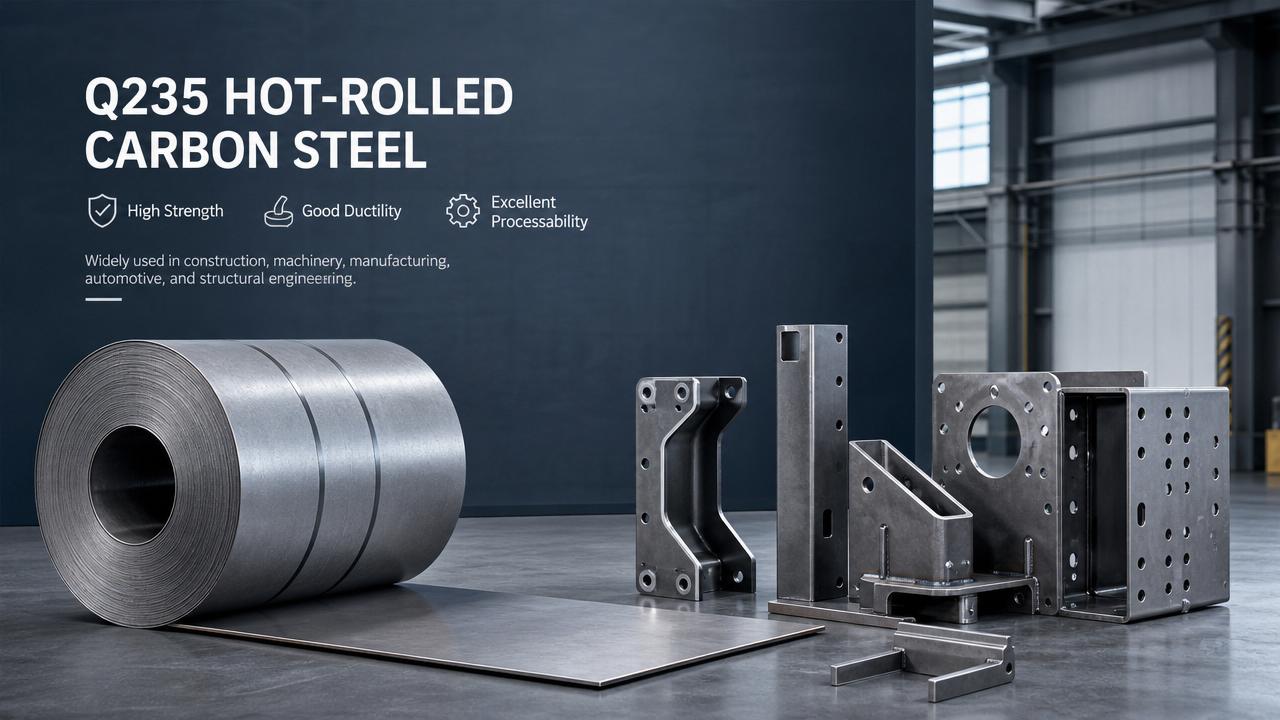
Q235 Hot Rolled Carbon Steel Coil: Why Its Property Balance Matters
For technical evaluators, Q235 hot rolled carbon steel coil is rarely selected on strength alone.
The real decision usually depends on how strength, ductility, weldability, and process stability work together.
That balance is exactly why Q235 hot rolled carbon steel coil remains common in fabrication, general structures, and formed parts.
It offers practical performance at a reasonable cost, but only when its limits are understood early.
In real projects, many downstream issues do not come from the grade itself.
They come from unrealistic forming expectations, loose dimensional control, or an incomplete review of surface and welding requirements.
This is why a technical review should look beyond the nominal grade name.
It should connect material data with actual manufacturing steps, tolerance windows, and end-use risks.
What Q235 Hot Rolled Carbon Steel Coil Typically Means
Q235 is a widely used carbon structural steel grade in the Chinese standard system.
In coil form, it is often supplied for cutting, bending, welding, roll forming, and light structural fabrication.
Q235 hot rolled carbon steel coil is usually chosen when a project needs balanced mechanical performance instead of high-strength specialization.
Its chemistry is generally low carbon, which supports basic formability and good weld response.
However, supply condition still matters.
Hot rolling scale, thickness range, cooling practice, and mill control can all shift real processing behavior.
That also means two coils labeled Q235 may behave slightly differently during flattening, punching, or edge trimming.
Key Mechanical Properties to Review First
When evaluating Q235 hot rolled carbon steel coil, four property groups usually deserve immediate attention.
1. Yield Strength
Yield strength defines when permanent deformation starts under load.
For Q235, the nominal expectation is around 235 MPa, though actual values can vary by thickness and supply condition.
This property matters for bracket rigidity, frame stability, and forming springback prediction.
2. Tensile Strength
Tensile strength shows the maximum stress the material can carry before fracture.
For Q235 hot rolled carbon steel coil, the typical range often supports general fabrication rather than critical high-load engineering.
It is useful for comparing safety margin across similar commercial grades.
3. Elongation
Elongation is a direct signal of ductility.
A stable elongation level helps with bending, shallow drawing, flanging, and shape correction.
Lower elongation often raises the risk of edge cracking, especially after slitting.
4. Weldability and Toughness
Q235 hot rolled carbon steel coil is generally considered easy to weld in standard shop conditions.
Its low carbon content supports this advantage.
Still, heat input, plate thickness, and joint design can affect distortion and local hardness.
If the application sees impact loading or low temperatures, toughness review becomes more important.
Typical Property Reference Table
Property values should always be checked against the actual mill certificate and applicable standard.
Still, the table below gives a practical reference for Q235 hot rolled carbon steel coil screening.
Common Processing Limits That Affect Real Performance
The biggest mistakes often happen when Q235 hot rolled carbon steel coil is treated as universally forgiving.
It is versatile, but not unlimited.
Bending Radius Limits
Tight bends can expose variability in ductility, edge quality, and thickness consistency.
If the inside bend radius is too small, edge cracks may appear, especially on slit edges.
A safer review always links bend design to thickness, direction, and edge condition.
Thickness and Flatness Variation
Q235 hot rolled carbon steel coil can show broader tolerance behavior than precision cold-rolled products.
This matters in laser cutting, automated forming, and fit-up sensitive assemblies.
Crown, waviness, and residual shape issues may reduce process stability even when chemistry is acceptable.
Surface Scale and Coating Preparation
Hot rolled surface scale is normal, but it changes downstream treatment cost.
If painting, galvanizing, or precision welding is planned, cleaning requirements should be reviewed in advance.
Ignoring this step can create adhesion issues or inconsistent heat input.
Hole Expansion and Edge Cracking
Punching and flanging performance depend heavily on edge quality.
Even when Q235 hot rolled carbon steel coil meets tensile targets, poor slit edges may fail during expansion.
This is a common gap between lab data and workshop results.
Welding Distortion Control
Good weldability does not mean zero distortion risk.
Thin sections, long seams, and unbalanced heat input can cause warping.
For that reason, fixture design and sequence planning remain important with Q235 hot rolled carbon steel coil.
Where This Grade Fits Best
Q235 hot rolled carbon steel coil works best in applications that need cost-effective, general-purpose mechanical performance.
- Welded frames and supports
- General construction components
- Formed covers, panels, and brackets
- Storage systems and light equipment parts
- Base material for further cutting and fabrication
It becomes less ideal when a project requires deep drawing, very tight tolerances, or high impact performance.
In those cases, a more specialized steel grade may reduce risk and scrap.
A Practical Evaluation Checklist Before Approval
A solid review process can prevent many hidden costs linked to Q235 hot rolled carbon steel coil.
- Confirm the applicable standard, thickness range, and delivery condition.
- Check mill test data for yield strength, tensile strength, and elongation.
- Review flatness, thickness tolerance, and coil shape against process needs.
- Match bend radius and forming severity to real ductility expectations.
- Assess surface scale impact on coating, welding, or cleaning operations.
- Verify slit edge quality if punching, flanging, or expansion is involved.
- Request trial processing if the part design sits near forming limits.
This type of screening is simple, but it often delivers the clearest cost control signal.
Final Takeaway
Q235 hot rolled carbon steel coil remains a dependable option because it balances strength, formability, weldability, and price.
Still, that balance only creates value when the processing window is realistic.
The most useful evaluation approach is practical rather than theoretical.
Read the certificate, review the forming path, check tolerance sensitivity, and test edge-related operations early.
When Q235 hot rolled carbon steel coil is matched correctly to the part and process, it usually delivers stable fabrication and competitive total cost.
That is the point where technical evaluation becomes a real purchasing and production advantage.
Get real-time quotes
Interested? Leave your contact details.