
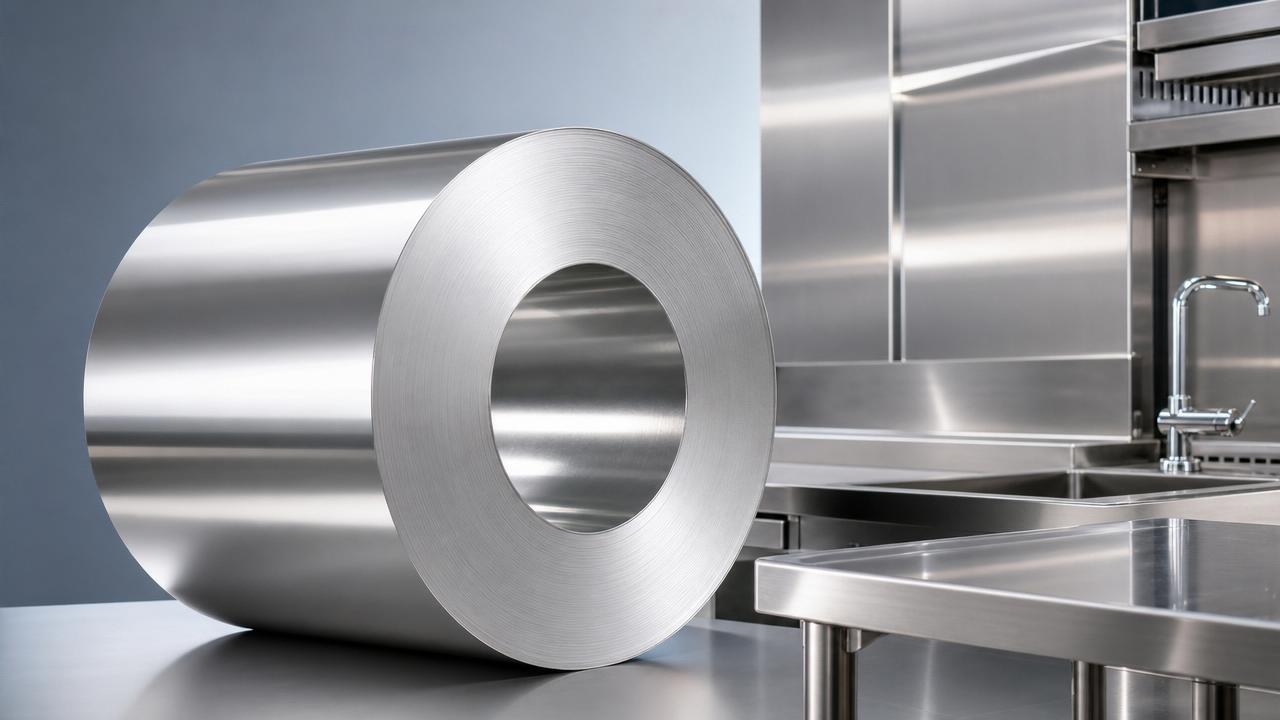
Where 304 Cold Rolled Stainless Steel Coil Fits Best in Kitchen Equipment
Material choice shapes sanitation, service life, fabrication stability, and replacement cost in commercial and residential kitchen equipment.
That is why 304 cold rolled stainless steel coil appears so often in worktables, cabinets, sinks, panels, and food-contact assemblies.
Still, the right answer depends on how the equipment is used, cleaned, heated, and exposed to moisture or chemicals.
In practical terms, 304 cold rolled stainless steel coil is most valuable when appearance, hygiene, corrosion resistance, and forming consistency matter at the same time.
It becomes less ideal when chloride exposure is high, heat load is constant, or a lower-cost grade can meet the real duty cycle.
Why similar kitchen applications often need different material decisions
Kitchen equipment may look similar on a drawing, yet field conditions vary more than many specifications suggest.
A prep table in a dry bakery faces very different stress than a sink unit in a seafood kitchen.
Both may use 304 cold rolled stainless steel coil, but the decision logic is not the same.
Cold rolled material is usually selected for its smoother finish, tighter thickness control, and better surface quality.
Those advantages matter more in visible panels and sanitary surfaces than in hidden structural parts.
The key is to match the coil not only to the product type, but also to cleaning routines, contact media, fabrication method, and expected maintenance intervals.
Prep surfaces and visible panels are often the strongest match
For counters, splashbacks, cabinet doors, and enclosure panels, 304 cold rolled stainless steel coil is usually a balanced choice.
These parts need a clean appearance, stable flatness, and a surface that handles repeated wiping without quick degradation.
In these scenarios, the fine finish of cold rolled stainless steel supports both aesthetics and easier daily cleaning.
Another reason is fabrication predictability. Bending, stamping, and panel forming benefit from consistent thickness and surface condition.
That reduces visible defects after polishing, laminating, or protective film removal.
When equipment is customer-facing, 304 cold rolled stainless steel coil usually delivers better value than rougher alternatives.
What matters most in these applications
- Surface finish consistency across batches
- Good resistance to food stains and routine cleaners
- Low rework risk after forming and welding
- Stable appearance under frequent touch and wiping
Wet zones need closer judgment than dry zones
Sinks, drainboards, dish handling areas, and cleaning stations create a more demanding environment.
Here, 304 cold rolled stainless steel coil still performs well in many cases, especially where water exposure is frequent but controlled.
The caution starts when standing water, chlorides, bleach, or salty residues remain on the surface for long periods.
This is where many projects make a costly assumption.
They see “stainless” and expect the same result in every wet area, even when cleaning chemicals and food residues are aggressive.
In actual use, 304 cold rolled stainless steel coil is suitable for many wet-zone parts, but edge finishing, weld treatment, and drainage design become just as important as the grade itself.
A practical comparison of common kitchen conditions
The table shows why one stainless solution does not cover every kitchen duty equally well.
Food-contact parts and storage equipment call for balanced decisions
Shelving, ingredient bins, refrigerator liners, and food-contact panels sit between dry and wet service conditions.
These applications often favor 304 cold rolled stainless steel coil because they need corrosion resistance without sacrificing a smooth, sanitary finish.
The smoother surface can help reduce residue retention and simplify cleaning validation.
At the same time, not every food-contact component needs the same thickness, finish, or hardness level.
A liner panel, a formed tray, and a reinforced shelf may all begin with 304 cold rolled stainless steel coil, yet require different processing priorities.
In real projects, the better approach is to define where hygiene matters most, where load matters most, and where appearance matters most.
Useful checks before finalizing the coil specification
- Confirm contact with acidic, salty, or oily food materials
- Review whether the part is brushed, polished, stamped, or deep drawn
- Check if weld seams remain exposed after assembly
- Match thickness to load, span, and reinforcement design
Heat exposure changes the answer faster than many teams expect
Kitchen equipment does not need to be inside a flame zone to face heat-related material limits.
Side panels near ovens, hoods above cooking lines, and guards around heated modules can see repeated thermal cycling.
In these cases, 304 cold rolled stainless steel coil may still work, but the decision should include temperature range, expansion behavior, and finish stability.
If the part must stay dimensionally stable under continuous heat, another grade or a different design may be more appropriate.
This is a common point of confusion because equipment surfaces can look undamaged early on, then show distortion or discoloration later.
So the question is not only whether 304 cold rolled stainless steel coil survives the heat, but whether it preserves function and finish over time.
The most common mistakes happen outside the datasheet
A material decision can look correct on paper and still underperform in service.
One frequent mistake is focusing only on grade while ignoring post-fabrication treatment.
Poor weld cleanup, rough cut edges, and trapped moisture can shorten the useful life of 304 cold rolled stainless steel coil parts.
Another mistake is comparing only purchase price.
A lower-cost alternative may require more maintenance, more protective finishing, or earlier replacement.
There is also the opposite mistake: specifying 304 cold rolled stainless steel coil everywhere, even in concealed parts with low corrosion exposure and low hygiene sensitivity.
That can raise cost without creating practical value.
Warning signs that the specification needs another review
- The environment includes bleach, brine, or marine air
- The part stays wet because drainage is weak
- Heavy forming is required but temper is undefined
- Surface appearance is critical but finish standard is unclear
- The drawing ignores edge condition and weld treatment
How to decide if 304 cold rolled stainless steel coil is the right choice
A reliable decision starts with separating visible surfaces, food-contact areas, wet zones, and heat-adjacent parts.
Then review actual cleaning chemicals, contact media, forming complexity, and expected service intervals.
If the application needs a clean finish, dependable corrosion resistance, and repeatable fabrication, 304 cold rolled stainless steel coil is often a strong candidate.
If chloride exposure, thermal stress, or cost pressure dominates, the better path may be a different grade, mixed-material strategy, or redesigned detail.
Before locking the specification, compare sample conditions, not just catalog claims.
Check surface finish, fabrication route, welding practice, maintenance cycle, and full-life cost together.
That is usually where the right use of 304 cold rolled stainless steel coil becomes clear.
Get real-time quotes
Interested? Leave your contact details.