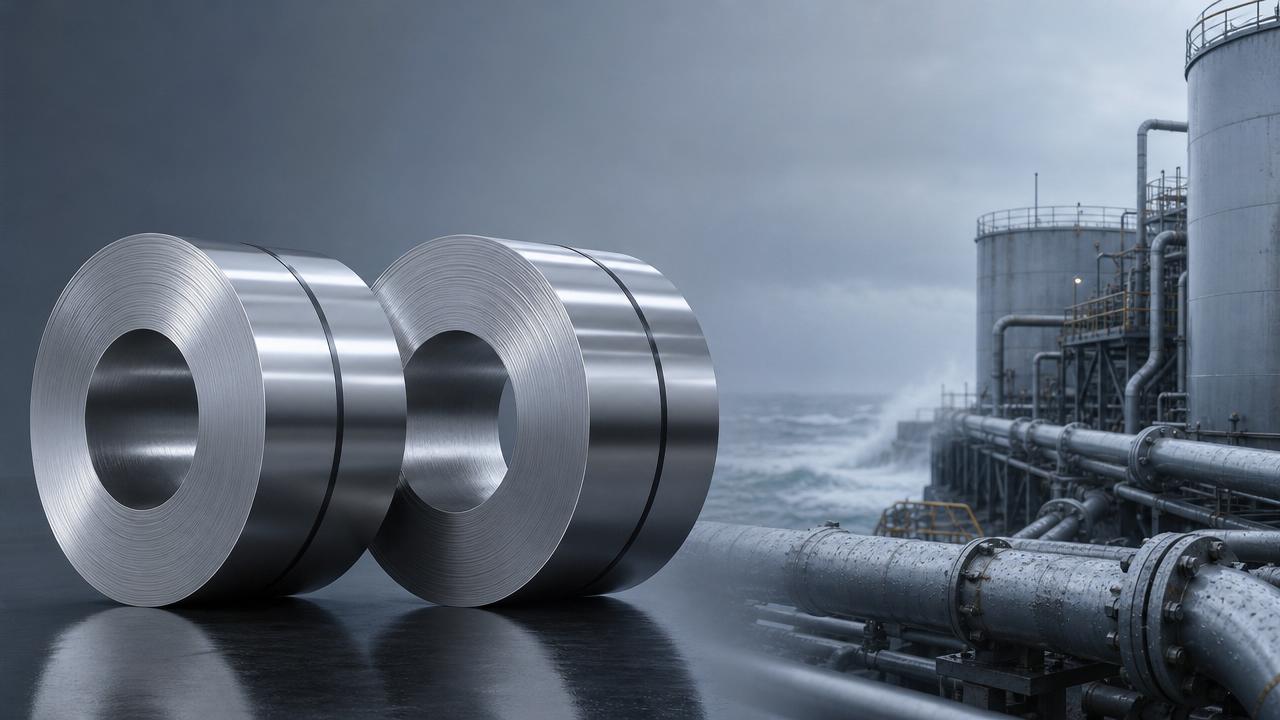
316L Anti-Corrosion Stainless Steel Coil vs 304: Which One Fits Chloride Environments?
When chloride exposure becomes a critical factor in material selection, the choice between 304 and 316L can directly affect service life, maintenance costs, and project risk.
This article looks at how 316L anti-corrosion stainless steel coil performs in chloride-heavy conditions and where 304 may still be good enough.
For project planning, the real question is not which grade is better in theory. It is which one delivers the lowest risk per dollar in the actual service environment.
Why Chloride Environments Change the Decision
Chlorides are aggressive. They attack the passive film that normally protects stainless steel from corrosion.
That attack often shows up as pitting, crevice corrosion, or stress corrosion cracking, especially when moisture and heat are present.
In practical terms, this means coastal sites, desalination plants, chemical facilities, food processing lines, and water treatment systems need stricter material screening.
A grade that works well indoors may fail much faster outdoors near sea spray or in contact with chloride-bearing process fluids.
304 vs 316L: The Core Material Difference
Both 304 and 316L are austenitic stainless steels. Both offer good formability, weldability, and broad industrial use.
The key difference is alloy chemistry. 316L contains molybdenum, while 304 generally does not.
That molybdenum addition significantly improves resistance to chloride-induced pitting and crevice corrosion.
The “L” in 316L means low carbon. This helps reduce sensitization risk after welding.
For fabricated systems with many welds, 316L anti-corrosion stainless steel coil can therefore offer both corrosion and processing advantages.
Quick Comparison
How 316L Performs in Chloride Service
This is where 316L anti-corrosion stainless steel coil usually pulls ahead in a clear and measurable way.
Its enhanced resistance helps delay localized corrosion, which is often the hidden cause of early equipment failure.
That matters because pitting does not always look serious at first. Yet it can quickly reduce wall thickness and compromise structural reliability.
In wet marine air, chloride cleaning chemicals, or brackish water systems, 316L anti-corrosion stainless steel coil usually maintains surface stability longer than 304.
That longer resistance window often translates into fewer shutdowns, less unplanned maintenance, and a more predictable operating budget.
Typical Benefits in Real Projects
- Lower risk of pitting in chloride splash zones.
- Better durability around welded joints and formed sections.
- Longer maintenance cycles in corrosive service.
- More stable lifecycle cost in exposed infrastructure.
When 304 Still Makes Sense
Choosing 316L does not mean 304 is obsolete. The right answer still depends on actual exposure level.
304 can remain a cost-effective option for indoor systems, dry environments, and applications with limited chloride contact.
If cleaning cycles are mild, temperatures are controlled, and design avoids crevices, 304 may perform adequately.
This is especially true when replacement is easy, downtime is not critical, and corrosion failure would not create major safety or contractual risk.
304 Is More Reasonable If
- The site is away from marine or deicing salt exposure.
- The system stays mostly dry during service.
- Frequent inspections are already built into operations.
- Budget pressure outweighs long-term corrosion uncertainty.
Cost Efficiency: Initial Price vs Lifecycle Value
The price gap between 304 and 316L often drives early discussions. That is understandable, but it should not end the evaluation.
A lower purchase price can become expensive if corrosion leads to leaks, aesthetic damage, contamination, or emergency replacement.
In chloride-heavy service, 316L anti-corrosion stainless steel coil often wins on total cost because it reduces intervention frequency.
That lifecycle advantage becomes stronger when labor access is difficult or when outages directly affect production targets.
From a project control angle, fewer surprises usually matter more than saving a small percentage on day one.
Hidden Cost Factors to Include
- Inspection frequency and reporting workload.
- Cleaning, passivation, and repair effort.
- Operational loss during shutdowns.
- Compliance or warranty exposure after premature corrosion.
Application Scenarios: Where 316L Is Usually the Safer Choice
Some conditions make the case for 316L anti-corrosion stainless steel coil much stronger from the start.
- Coastal architecture exposed to salt-laden air.
- Heat exchangers and tanks using brine or saline media.
- Food and beverage lines using chloride-based cleaners.
- Wastewater and desalination equipment.
- Chemical process components with trapped moisture and crevices.
In these settings, corrosion is rarely a theoretical issue. It is a schedule, safety, and budget issue.
That is why many teams use 316L anti-corrosion stainless steel coil not as an upgrade, but as a risk control decision.
A Practical Selection Framework
If the decision is still close, a simple evaluation framework can help move the discussion from preference to evidence.
Step 1: Define the Chloride Source
Identify whether exposure comes from seawater, cleaning agents, process media, road salt, or airborne marine deposition.
Step 2: Estimate Contact Severity
Ask how often the surface gets wet, how long it stays wet, and whether chlorides can concentrate in gaps.
Step 3: Review Fabrication Details
Look at weld density, bend areas, drainage design, and surface finish. These details strongly affect corrosion behavior.
Step 4: Calculate Failure Impact
Consider downtime, replacement access, safety exposure, product contamination, and contractual penalties.
Step 5: Compare Lifecycle Scenarios
Run a realistic cost comparison across five to ten years. In many chloride cases, 316L anti-corrosion stainless steel coil comes out ahead.
Final Takeaway
If chloride exposure is occasional and mild, 304 may still be a rational choice with the right design and maintenance plan.
If chloride exposure is regular, concentrated, or hard to control, 316L anti-corrosion stainless steel coil is usually the more dependable option.
The better decision is not the cheaper grade on paper. It is the grade that keeps corrosion risk aligned with project goals.
Before finalizing procurement, match the material to the real chloride profile, fabrication method, and maintenance capacity.
That approach leads to a cleaner specification, a more stable budget, and a much higher chance of long-term performance.
Get real-time quotes
Interested? Leave your contact details.